
Study Space Guide: Lighting & Ergonomics for Students
From high school exam reviews to college thesis drafting across Metro Manila, Cebu, and provincial campuses, students often study in shared bedrooms or crowded family spaces. Learn how to craft a focused, comfortable study zone that protects your eyes during late hours without disturbing roommates or family.
Philippine Student Living Conditions
Many student lifestyle guides assume large private bedrooms with dedicated executive study desks. In reality, most Filipino students study in shared family spaces, multi-occupant boarding houses near university belts (such as U-Belt Manila or Katipunan), or studio condominiums with compact study corners.
Common challenges include:
- Exposed overhead fluorescent tubes that cast deep shadows when you lean over your notebooks.
- Limited desk depth (often 50 cm to 60 cm), leaving little room for open textbooks alongside laptops.
- Studying late into the night while roommates or siblings are trying to sleep in the same room.
Small Desks & Shared Rooms: Space-Saving Lighting
When desk real estate is scarce, traditional bulky desk lamps with wide bases are impractical. Instead, adopt these student-proven alternatives:
- Flexible Clip-On Gooseneck Lamp: Clips onto a desk edge, headboard, or bookshelf. It consumes zero desk surface and can be angled with pinpoint accuracy onto textbook pages.
- Monitor Light Bar: If your desk hosts both a monitor/laptop and handwritten notes, a light bar illuminates the physical paper directly in front of the keyboard without reflecting on the screen.
- Collapsible Book Stand (Reading Easel): Elevates heavy textbooks at a 45° angle. This aligns text with your natural line of sight, preventing hunchback posture and reducing shadows cast by your head.
Preventing Shadows While Writing Notes
When you lean forward to solve equations or write essay drafts, your head and hand naturally block overhead ceiling lights. This creates a dark shadow directly over the line you are currently writing.
The Opposite-Side Rule
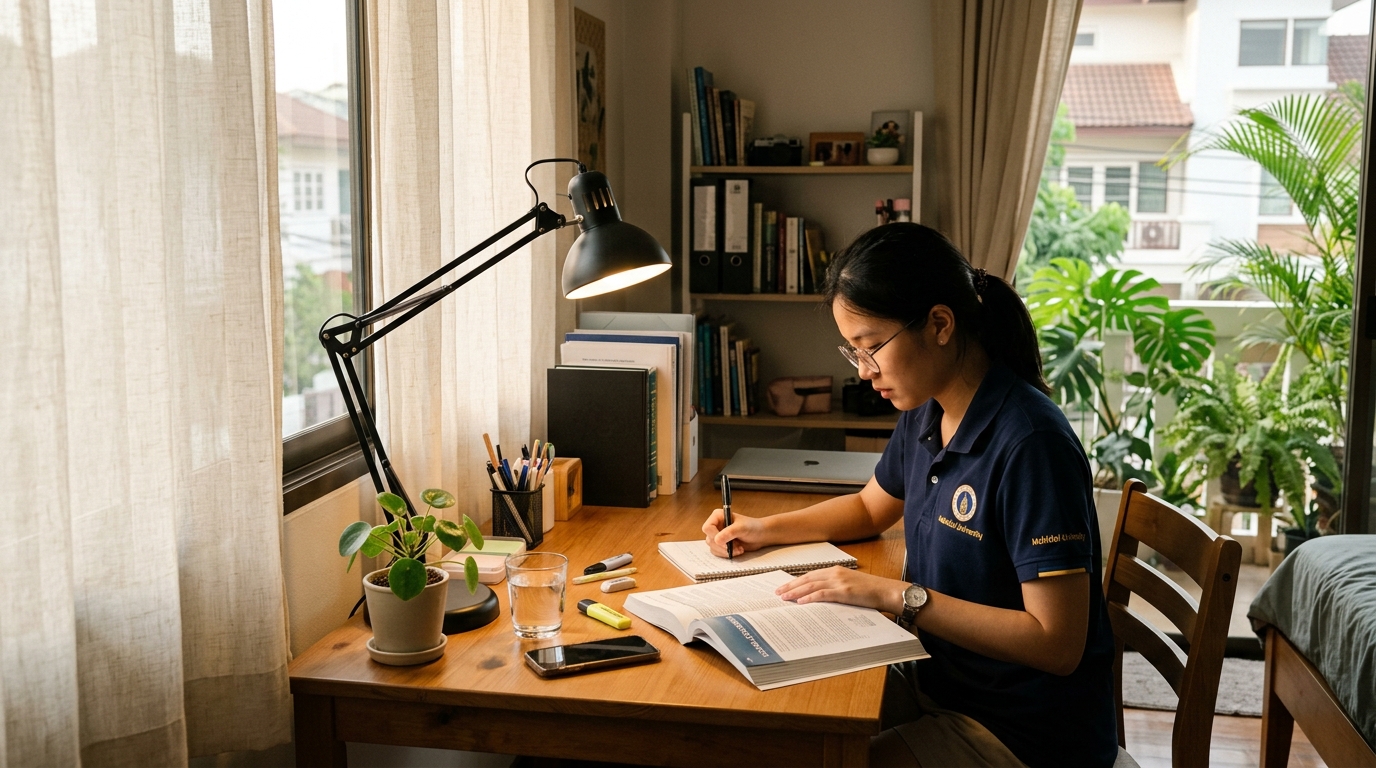
Always place your desk lamp on the opposite side of your dominant hand. If you are right-handed, place the light on the left side of the desk; if you are left-handed, place it on the right side. Light sweeps across your paper cleanly without your hand casting a shadow over newly written ink.
Late-Night Study: Sleep Hygiene & Light Warmth
During late-night study sessions before exams, exposure to cool white light (5000K–6500K) suppresses melatonin, making it difficult to fall asleep even after closing your books at 1:00 AM.
Switch your desk lamp to a warm setting (2700K–3000K) and activate night-mode color filters (such as Night Light on Windows or Night Shift on Mac/iPad) after 8:00 PM. Warm light provides ample contrast for reading while keeping your circadian rhythm balanced.